Friday, January 18, 2013

Hampton and Cameron off to Great Start 2013


Hampton

At Hampton we are off to a great start in 2013. The students at Hampton are not singing the Blues. They are hard at work learning all there is to know about the “Call and responses singing of spirituals”.  Hampton students are discovery and exploration singing to get ready for their Opera. To get started in there exploration of their voices, we are studying spirituals.  At Hampton we are eagerly learning all about the history of the folk song style of Spirituals. Originally monophonic and a cappella and were antecedents of the blues- spirituals have a simple melodies and repeated text, get learning tools for new singers, needing practice with their instruments. Spirituals sometimes provided comfort and eased the boredom of daily tasks. They were an expression of spiritual devotion and a yearning for freedom from bondage. Sometimes they were a means of releasing pent up emotions and expressing sorrow. But at Hampton we are studying the “Call and Response” relationship of the singing of spirituals. My teaching partner Lisa Golda and I began each class with a performance for three spirituals, “Wade in the Water”, “My Lord What a Mornin”, “Sometimes I feel Like a Motherless Chil” Then we performed each song in call and response, no matter what line I sang as the call, Lisa sang it as a response. As always we had to have fun with, so we changed the rhythms and pitch of ‘call and response’ to keep the class interested, and they wanted to take part right away.


Take a look at this Game for classroom: Tap Your Feet
Students will practice following a pattern and become familiar with the concept of beat in music. They will be introduced to tempo. They will gain experience playing the beat on non-pitched rhythm instruments, at various tempos. This activity will culminate in the creation of a rhythm piece.
Objectives:
  • Students will listen to, analyze, and describe music.
  • Students will gain experience performing on instruments, alone and with others, a varied repertoire of music.
  • Students will gain experience composing and arranging music within specified guidelines.
  • Students will gain experience in speaking and listening as tools for learning.
Materials:
  • Computer(s) with Internet access will be used for online activity
  • Available non-pitched rhythm instruments
  • Picture cards of non-pitched instruments with the names of the instruments written below the picture
  • Big book stand, music stand, flannel board-anything to arrange cards in sequence from left to right
Procedure:
  1. AccessPBS's Bandleader. Have the students work in the first level to gain experience with following a pattern.
  2. Have the group find their individual heartbeats by placing their hands on their chests. Have them tap along with their heartbeat.
  3. Do a few simple exercises/movements with the children to raise their heartbeat. Immediately following this, have them find their heartbeat again. Ask them what they notice. Is their heart beating faster or slower? (Tempo) Explain that music can also have a fast beat or slow beat.
  4. AccessPBS's Bandleader. As a class, create a composition. Listen several times and help the children keep the beat with the created composition using a different type of body percussion (pat, tap, clap, etc.) each time. Students will attempt to follow a pattern.
  5. Continue to develop the concept of beat in music, creating a "beat" composition using a variety of non pitched instruments. Have the children select an instrument (i.e. hand drum) and play a group of four beats. Allow children to take turns as necessary, while others practice with body percussion.
  6. After the students have practiced groups of four beats on the various instruments; ask them to suggest a sequence for the instruments to play in. Arrange the picture cards in the sequence the students have selected from left to right. Guide them in playing this rhythm composition.
  7. Compose a variety of these compositions. Play at various tempos. Try having children play instruments in combinations (i.e. hand drum and maracas together, triangle and claves).
Assessment:
  • Students should actively participate in all activities.
  • Teacher assessment of student's ability to keep a steady beat through observation.
Extensions and Adaptations
  • Continue to develop the beat by using it with picture books and poems. When reading to children, look for text that is rhythmic. Help students select appropriate places to insert beat patterns in the story/poem.
  • Listen to a variety of music with children and have them determine the beat and play along.
Relevant National Standards:
Music
Performing on instruments, alone and with others, a varied repertoire of music.
Composing and arranging music within specified guidelines.
Listening to, analyzing, and describing music.
Language Arts
Demonstrates competence in speaking and listening as tools for learning.

Cameron

At Cameron we are off to a fresh new start for 2013. In the afterschool program at Cameron, we now have a new day of the week( Wednesday) and a new time, so students can take a fresh look at Opera for all at Cameron. I don’t want to Jinks us, but we had more than twenty students this Wednesday, at some point or another. Already to explore opera, staging and acting and improv games for fun. The group of five 3rd graders, ten 5th and 6th graders, and five 7th and 8th graders, loved Zip ZapZog and “The Impossible Dream” from Man of La Mancha. This semester students will focus on singing in groups and their cultures, to develop a story for the Sharing at the end of the year. So getting the students to connect with the inner opera singer and not be shy, was the Challenge of the Year. Check out the video below of class.


Call and Response models ways to read fluently and with meaning and invites students to participate in an aesthetic reading of a text. For those students who have difficulty with reading, Call and Response provides an opportunity to practice reading a text as a community without being singled out. The activity Call and Response comes out of traditions in the African American church and hip-hop concerts, where vocal participation is encouraged.

Duration: 10 minutes

Preparation: Before class, select a list of key phrases or sentences from the designated text. Virtually any lines can work, though the best choices are lines that carry an emotional or aesthetic punch and that are essential to an understanding of the text.

Procedure:  The class gathers in a large circle. Everyone in the room needs to be able to make eye contact with one another. Ask the students to pull their shoulders back, take their hands out of their pockets, and avoid crossing their arms during the vocal warm-up. This will help them to open their voices, to speak with conviction and clarity. Next, walk into the center of the space and call out lines of text. The students repeat the lines back in chorus. Read with emotion, matching the tone of the text and encouraging students to match the energy and quality of the reading.

You might then playfully point to individual students and challenge them to match your level of energy. The warm-up continues with many lines, moving back and forth between you, individual students, and the entire group.

This activity can become a daily ritual in the classroom. As students become comfortable, they can take over the lead, calling out the lines to the rest of the group. It’s important for student leaders to review the text carefully beforehand, choosing, marking, and practicing the lines they will lead the class in reading. This makes an excellent and purposeful homework assignment. 

In Daniel and Kurt’s final performance at Brown Summer High School, the Call and Response became the opening event. An entire class stood on the stage in a U formation. Standing in the center, three student leaders called out lines from Whitman. The class, and eventually the entire auditorium, repeated the lines in response. The class then added a Brazilian choral melody, accompanied by a guitar, between the calls and responses: “I celebrate myself . . . and sing myself.”

Reflection: Based on the lines you heard in the Call and Response, what predictions can you make about the text?  What was your favorite line of today’s Call and Response?


Thursday, December 13, 2012

Chicago Opera Theater for Teens


Chris Richard, COT for Teens Teaching Artist
 
What a way end the semester... with a trial!  A Trial By Jury - The Gilbert & Sullivan one act operetta, that is!

On December 7 & 8 the Chicago Opera Theater for Teens group performed at The Chicago Temple.  The students did a great job and Marta and I were very pleased.  We had not attempted doing an entire opera, and this was a perfect fit.  The one act opera lasts about 35 minutes and there is no dialogue - ALL MUSIC.  We didn't have to cut a thing.  The show provided wonderful opportunities for some of the students to really shine with individual roles.  We double cast the show to give as many solo opportunities as possible. 


The cast of characters included:
The Plaintiff (Angelina), a lovely soprano role sung by Genna Simon and Morgan Holmes
The Defendant (Edwin), a scoundrel of a tenor role sung by Marcellus Burt and Torin Brown
The Judge, a comic baritone role perfect for Sakhary Prayer and Brando Crawford
The Counsel, an empathetic tenor role sung by Xxavier Jenkins and Andre Cardine
The Usher, a bass role split between Marc Morey and adapted to fit a mezzo Ruth Odukoya
Both casts did an excellent job!
This term went rather smoothly. The show being a little shorter then we have attempted in the past seemed to let us all breath a little and allowed everyone to really feel comfortable in their parts.  We decided to let the students have a huge part in the costuming.  We all batted around a couple of ideas on how we could dress.  The possibilities were endless, but ultimately we decided to let every individual come up with a kind of 'iconic' societal character - i.e. we had a cowboy, a monk, a hippie, a ballerina, a volleyball player, a karate student, and so on and so on....  The students really took to mostly coming up with their own ideas and I think that gave them a sense that this whole was really about them!  As we delved into the staging we reminded the students of the character choice and guided them to react to the situations with appropriate body language for their particular character.  If you weren't able to come to one of the performances you missed some hilarious moments!
I think every single student grew from this experience.  Marta and I could hear the strides the students made vocally and certainly their acting and self awareness abounded.  We are proud of them all!!!

Friday, December 7, 2012

Lyricist Week at Opera for All

Alyssa Sorresso, COT Teaching Artist and Lyricist

What a whirl-a-wind of a week! As the special guest lyricist, I visited almost all our program sites, working with 14 different classes on their songwriting skills. It was a TON of fun to see where all my fellow teaching artists are facilitating as well as meet all their fantastically talented students!

So, let's talk about method. My background in lyric writing stems from creating songs that originate from narrative writing and scriptwriting: to put in it simpler terms, I normally write the story and/or script first, and allow that material to inspire my songs. In the case of Opera for All, we are primarily working with outlines and budding ideas of story lines which poses a different challenge: write a song and form the majority of the script around it. 

My partner teaching artists were all very helpful in getting as much material prepared for my workshop as possible.  My goal was to address each class with a personalized songwriting workshop, generating a song that would fit in with the main idea of their opera.  Additionally, since many of the workshops were in the beginning stages of developing story lines, I wanted to help flush out the plot and characters.  This way, the resulting song would either introduce the main conflict, help it move forward or resolve it. Having a structured and specific approach to songwriting is the key to a more fun and effective workshop for the students!

The first site I visited was the St. Vincent de Paul Center (SVDP) with teaching artists Justin and Bryna. Their two classes were focused on creating a song about Makin' Magic Happen. Since their students were a variety of ages, I decided playing an active game called Magician would help get them thinking about Magic on the same level. After the game, we split into small groups and wrote verses responding to questions about Magic and how the characters in their opera might feel about Magic. The workshop at SVDP was the most challenging in that we didn't necessarily have a story line to work with, but through working on the song, the students started to brainstorm ideas they wanted to have in their performance. 

Next up was Marillac, another after-school program with TA's Lisa and Justin.  Lisa and Justin face a similar situation as SVDP in that their group had the seed of an idea for their opera; their classes were inspired by a scene from 2001: A Space Odyssey. They invented a situation about a girl who travels through a black hole to get away from her parents.  I decided to modify my workshop plan as I had heard Marillac's students loved playing an improvisational song game, and were quite good at coming up with lyrics on the spot. We used this game as a starting point for singing about/discussing the opera's plot, as well as having the students freestyle about traveling through a black hole from the viewpoint of the girl. 

Our first class did a super job at this game- they were so good and so focused that we played throughout the entire class time. The second group was a bit more to handle, so I switched it up by breaking them up into 3 small groups.  We assigned each group a part of the song to focus on and for which to write at least 2 verses. I had three girls who were not only best friends, but amazing lyricists! We tackled the beginning of the song, before the girl goes into the black hole, and the reasons why she ran away from her parents.  Then all the groups shared with each other in the end, even adding on blocking for their song! They were really engaged in the process. 


My final classes of the week was at Hampton with Lisa and Richard.  These classes had done a lot of brainstorming already on the plot and characters.  Beforehand, Lisa and I came up with what song we wanted each class to write.  Since these students are in-school, we were able to do a little more in terms of teaching the actual structure of a song and defining lyric-writing concepts such as how verses support the chorus, what it means to scan you rhythm and how to choose a rhyme scheme. 

Following a general overview of songwriting, we then mapped out our song from beginning to end. The students decided on what important details to include in order to help the audience understand the story. For example, Ms. Ochoa's class wrote a song about the Sacred Garden on the Planet Zyrdek, sung by the Beardnuggets, Space Doggies and the Gardeners, all governed by Princess Roseberry. We decided what would be in the garden, how the characters felt about their garden, why it was important to them and who they were tending it for.  Small groups each took parts of the song to write a 4 line, rhyming verse containing the information.  I loved how creative they were with the different species of plant that were in the garden- particularly having a Golden Flower that was in the center of the garden, and therefore the most important plant.


To the 6th graders in Mr. McFarland's class I put the biggest challenge. Their song introduced the characters in Hampton's opera about the Sun going Supernova, and Earth choosing 8 specialists for a mission to the Planet Zrydek. Instead of just 4-line verses, I tasked the students with writing 2, 4-line rhyming verses (8 lines in all) that introduced each specialist, included information about what they did for a living, how they felt about the mission and what they hoped to accomplish.  I have to say, I was really impressed with the quality of their work! 8 lines is a lot to write in 25 minutes, but the students put their heads and talents together to write some very clever lyrics:


I still have Clinton to visit as well as leading my own workshops at Chase and Reilly in a songwriting adventure.  I'm excited to keep experimenting with the songwriting process to get the best results for every site-- I know the students will continue to be a huge source of inspiration!

Thursday, December 6, 2012

All Students see an Operetta, Knightly News!

Linden Christ, Manager of Education and Outreach and Founder of Chicago Opera Playhouse
 
Every year, all of our schools look forward to seeing an operetta or musical at their school performed just for the students!   It is not just for the Opera for All (OFA) students, but a rare experience that the entire school gets to share.  This year, Chicago Opera Playhouse performed the brand new operetta, Knightly News by Jonathan Stinson.  The OFA students worked several weeks with their teaching artists to practice the finale chorus which they joined in singing with the professionals at the end of the show.   School pride was bubbling over for the students when they were able to perform in front of the whole school.    Their schoolmates were proud of them and equally as enamored by the opera.

Providing students with the opportunity to see an opera in their own school setting is very rewarding.  The students are comfortable and enjoy the performance wholly.  No one was able to keep quiet the entire time, but were chattering quietly about their favorite part, the storyline, and what they thought was funny.  For many of the students, this was their first time to see an opera and will help prepare them to watch their peers in the Opera For All program at their Spring opera performance.  

The partnership between Chicago Opera Theater's Opera for All program and Chicago Opera Playhouse is one I hope continues as it enriches the students' and actors' lives equally.  
About the Show:
Knightly News is an operatic news broadcast of the woes of Prince Charming and his Tri-kingdom state of affairs, including his own search for a princess, a missing Grandmother, and frighteningly strong winds that are blowing down houses in the land. This fun-filled show had the entire student body talking about fairy-tales and humming melodies for weeks to come!

The students favorite parts included the Wolf playing maracas and interrupting Prince Charming's solo.   Everyone was laughing when the character broke the 4th wall during the chase scene when the students had to protect Little Red Riding Hood & Pyg from that Big Bad Wolf.    They survived with a quick swipe of the slipper thanks to the Wolf that knocked the Prince straight to the floor!

To learn more about Knightly News and to schedule a performance for the children in your life visit: www.chicagooperaplayhouse.com

Thursday, November 29, 2012

Opera and Theatre games - Round 2

Richard Blakeney, COT Teaching Artist

Hampton Elementary School

This year at Hampton is moving quite fast as we prepare for our Winter Showcase, December 13th at 2pm.  The students voices can be heard rehearsing The Boy and the Wolf and Se Vuol Ballare every Thursday morning.  They are ready to impress their parents and friends with their stage presence and teamwork, not to mention their Italian.  We have also been rehearsing for their Knightly News performance that was on November 19th.  It was a huge hit with the students at Hampton.  I would not be lying if I said that the Young Artists' Voices rang through the halls of Hampton Elementary during their visit.  They received applause and cheer from teacher and student alike.  We lost a week to Turkey Day, so now we have to work extra hard to get ready for the 13th.  Here is one game we have been playing to enhance student engagement and reinforce positive behavior.  It can also be used for classroom management and creative expression.  Call and Response, with clapping and voice cues are used every day in Hampton's opera class.


Duration: 10 minutes
Preparation: 
Before class, select a list of key phrases or sentences from the designated text. Virtually any lines can work, though the best choices are lines that carry an emotional or aesthetic punch and that are essential to an understanding of the text.
Procedure:
The class gathers in a large circle. Everyone in the room needs to be able to make eye contact with one another. Ask the students to pull their shoulders back, take their hands out of their pockets, and avoid crossing their arms during the vocal warm-up. This will help them to open their voices, to speak with conviction and clarity. Next, walk into the center of the space and call out lines of text. The students repeat the lines back in chorus. Read with emotion, matching the tone of the text and encouraging students to match the energy and quality of the reading.
You might then playfully point to individual students and challenge them to match your level of energy. The warm-up continues with many lines moving back and forth between you, individual students, and the entire group.

Reflection: Based on the lines you heard in the Call and Response, what predictions can you make about the text?  What was your favorite line of today’s Call and Response?


Cameron Elementary School

This year at Cameron, the students' and parents' participation has started off more like a Blast of Activities for All instead of Opera for all.  As Amanda said, their program just started in the beinning of November and since then they have had performances of Knightly News and the Chicago Opera Theater Young Artists.  The audiences for these two performances were comprised of parents and students alike.  Even with all of that activity, the students have been excited to start acting, singing, and writing their own opera!  We have a visit with the lyricist, Alyssa, on December 7th and we are preparing by brainstorming and writing about potential characters, settings, and plotlines.  We have asked the students to create Space-themed writings, the theme of this year's Opera for All.  Here are three games we will be playing as we create text for our Space Opera.  Check out artslit.org for more classroom games.


Duration: 45-90 minutes

Procedure:
Divide students in the class into four or five groups. Ask each group to answer one of the questions from the character’s perspective, in first person. Certain qualities help monologues to be effective including: use active words, ask questions, speak in the first person, and have a beginning, middle, and end. Give students about twenty minutes in class to develop the monologues. Ask students at the end of class to share their drafts.

Continue to work on and revise monologues. When the monologues are ready, adapt the scenes from the text (see adapting the text activity), and insert the monologues into various points in the scene. The final performance will then be a combination of scenes from the actual text combined with student-generated monologues.

Reflection: 
What are the qualities of an effective monologue? What are the best ways to combine the monologues with adapted scenes? What do you learn about the characters by creating the monologues? What do you need to know about a character in order to create a monologue true to that character?

Duration: 20 minutes

Procedure:
Jan’s students each took a piece of paper and pen and sat in a chair or on the floor in a place where they were comfortable. She explained, “There is not a right way or a wrong way to write. This is your life. These are your stories, your words. Write as fast as you can. Don't take your pen off the paper.”
Jan then gave students a series of prompts for which they were to write quick lists, allowing a brief time for each topic. The students began writing. After about thirty seconds she instructed, “Stop. Draw a line across your paper. Don’t worry if you didn’t finish. This is about generating quick ideas. Next topic.” She had her students brainstorm in rapid succession the following topics:
• Foods you love to eat
• Images or things in your neighborhood
• Things you did when you were a child, toys you played with, memories, places you went
• Music you like to listen to, music that rocks your mind, settles your soul, music you listen to escape, lyrics from songs that come to you
• Things you love, things you love to do, your grandmother, your best friend, climbing on mountains, taking a vacation, anything that comes to mind.
When students finished, Jan explained, “This will be your cheat sheet, the notes you will use. I will give you a poetry prompt. Begin with the words ‘I come from.’ Use that phrase as often as you like and fill in with words from your lists. Play with it. Add to what you’ve written. Change it. It just helps to have something to begin with. You have 10 minutes to create a poem.”
Students worked silently on their poems using the rough ideas from their rapid brainstorming page. After about ten minutes, Jan instructed the students, “Pick up your paper with the poem on it; get up on your feet; walk around the room; just walk. Now read your poem out loud. Don't worry about anyone around you. Just start reading.” Students walked and read their poem aloud.
After a brief time, Jan stopped them and explained, “The next time you walk, I want you to edit the poem down to a size you would be brave enough to share in the room. Choose the parts you want to keep, and those you want to throw out. This is what I call editing on your feet. Take your pen with you. Add something new if you like.” Her students walked again, reading their poems and editing as they walked.
Jan instructed, “Find a partner. Introduce yourselves. You’re just going to read a little bit of your poem. Choose person A and B. A will read to B. B, please be the most respectful listener on the planet. Make eye contact, I won’t let you read for longer than a few seconds. Go.” Students read until Jan said, “Switch so that B is reading to A.” 
Jan then brought the class together in a circle. “First repeat after me ‘I' [everyone said ‘I’ in chorus], ‘Come,’ [chorus], ‘From,’ [chorus], ‘I Come From,’ [chorus]. Now we’ll go around the circle and you will share your edited poem with the rest of the class. Read as much of your poem as you are comfortable sharing. For you, maybe that’s just one line or one verse, or maybe it’s the whole poem. Share any part you want.”
That summer in Jan’s class, students read the novel Bless Me, Ultima by Rudolfo Anaya. After the students read their own poems, and before they began reading the novel, Jan gave an inspiring speech that captured the essence of why we read and why we write:
These are very personal poems. We're doing this as artists, as poets. This is how poets begin writing poems. They begin at the very beginning, by just using basic language, introducing themselves, telling a little bit about their story. And when we get into the Bless Me, Ultima, you’ll hear another person telling a story; and it's a lot more words, and that's the only difference.
Jan’s process of rapid brainstorming breaks down inhibitions and encourages innovation. We’ve used this process in a variety of classrooms when beginning different types of writing from narrative to poetic.

Duration: 20-30 minutes

Preparation:
Prior to this exercise, the participants had been exploring the concept of childhood spaces. Robert asked them to think of places that were important to them as children. In pairs, they shared their stories.
Procedure:
Robert then handed everyone a standard size sheet of paper. He demonstrated, folding the paper in half, then in half again to form four equal parts.
Robert explained, “In the first quadrant write the name of the place from one of the stories you told earlier. When I say go, start drawing circles around that word until another word comes to mind. Then quickly write that word and begin drawing circles around the new word until you think of another. Fill the first quadrant up with words and circles. Don’t take your pencil off the page. If you can’t think of another word, then keep making circles. You have about three minutes. Go!” 
In the second quadrant, Robert asked everyone to write an important question someone else might ask about the story, “something that is missing from the story as you previously told it. A very important detail or perhaps some background knowledge that you didn’t explain the first time around.”
In the third quadrant, Robert asked the participants to focus on the senses. He instructed, “There are five basic senses: seeing, hearing, smelling, tasting, and touching. Write a word for each of those five senses that relates to your story so you will know the story you are telling by just those five words. A sight. A sound. A taste. A texture. A smell.”
In the fourth quadrant, he asked everyone to write a headline that captured the essence of the story.
Robert then instructed, “Using all this rough material, take out a fresh sheet of paper and begin to write your story.”
Variations:
Over the years we have added variations to the four quadrants, depending on when and how we have used this tool in the writing process. We have asked students to do the following:
  • List the key objects in your story
  • Write a mini-dialogue between two characters
  • Sketch the setting of your story
  • Describe the setting
  • Describe one of the major characters in your story
  • Describe one of the minor characters in your story
  • List the major symbols in your story

A setback is just a setup for future success: Beginnings at Cameron

Amanda Compton, COT Teaching Artist

After much turmoil surrounding the teachers' strike and other various scheduling issues, we were finally able to bring our program to Cameron Elementary two weeks ago.  With a lucky twist of fate, we now have the students for an hour and forty minutes instead of just the normal hour, which will allow us to incorporate our lyricist, Alyssa Sorresso, this fall semester.  I have already had the privilege of working with Alyssa at Reilly Elementary to create lyrics reflecting everything from a heartfelt decision regarding divorced parents to a wacky language from outer space, and I am very excited to see what new ground we can explore at Cameron.

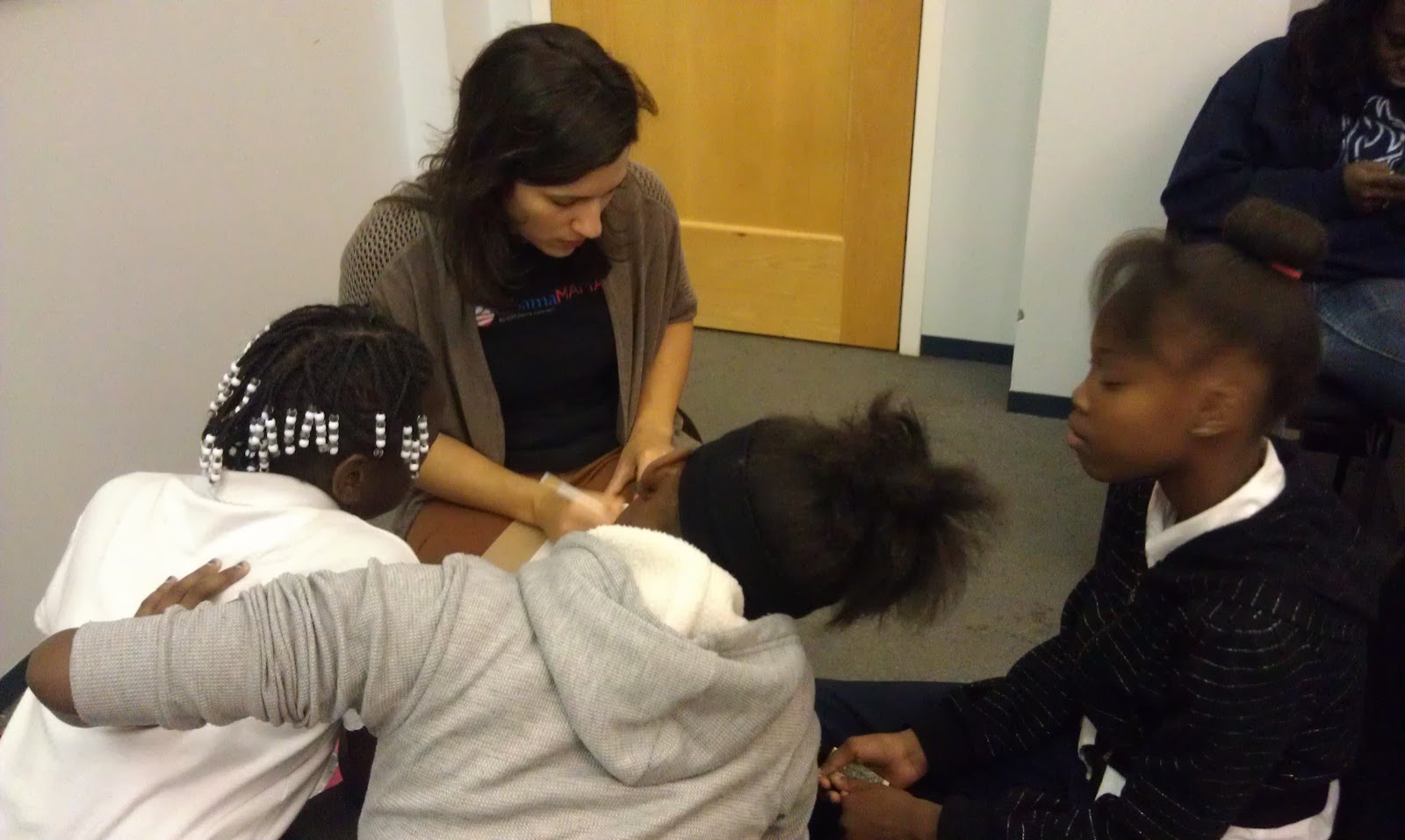
Cameron students with Teaching Artist, Richard


It is already clear that we have some seriously creative minds at Cameron.  Two of the children are veteran musicians of a local choir, two are percussionists in band, and a few others have shown us their enthusiasm for acting games.  But it is also clear that the group has some challenges to overcome.   We have one student that only speaks Spanish and needs our instructions translated during class.  We also have a few different age groups that are in different phases of their educational journey.  Therefore, my partner teacher, Richard Blakeney, and I decided it was most important to give the group a good foundation for working together and becoming a successful ensemble for their future production.  We made our expectations clear, and asked them what kind of behavior they thought would contribute to the production in a constructive way.  Together, we made this list of important elements:

Be respectful
Raise your hand to speak
Be courageous and participate during every session
Trust each other and work together to be creative 
Show responsibility by being prepared and doing what's asked of you
Be courteous and don't say bad words
Pay attention
Be honest

Once we all felt safe to express ourselves, the rest of the day was fun filled and energetic!  We began with an acting game that required the students to walk from their seat in the auditorium up to a lone folding chair.  The trick was to be a character other than yourself, and to show that character in your physicality alone.  The kids were already learning to take risks and add specificity to their motions when their character was not clear the first time.  Doctor Who was an especially and surprisingly popular source of inspiration...perfectly apropos of our outer space theme this year!

For the rest of class we honed in on rhythm.  I played some different excerpts of music, ranging from Black Eyed Peas, to Mozart, to Gershwin, and asked the kids to find the beat.  Most of the kids clapped to show the beat.  So I asked them to find the beat a different way, with a different part of their body.  Then silently.  Then "faster" or "slower" to get them attuned to different subdivisions of the beat.  They started to listen more actively, and became attuned to what their peers were doing with the directions until they were in sync with one another.  We delved even further into rhythm by learning the pulse of a quarter note, eighth note, triplet, and sixteenth note.  We related each note to a common, everyday object:

quarter note=phone
Eighth note=apple
Triplet=camera
Sixteenth=calculator

Once they got the hang of those pulses and different permutations of the order, we learned how musicians notate those rhythms, and created some original rhythms.  We then did solo and ensemble performances of the musical bars.  It was very inspiring to see the shyest children give it a try in front of their peers, and even better, to succeed.  I think we have a good balance of leaders and hard workers in this class, and I am looking forward to see where this unique and gifted group of children takes their show.  Be courageous, Cameron!  I will be there rooting for you!

Thursday, November 15, 2012

Chicago Opera Theater Young Artists Sing and Share

Jessica Lane, COT Education Assistant

It's as simple as the title sounds.  3 musicians from our Young Artists program (pianist and 2 singers) come with us for a day to each of the Opera for All schools and share what it is like to be them!  They sing arias and some selections from musicals for the students, connect it to what they are learning in the classroom, and talk about how they became opera singers.

In the past week I was able to see Matthan Black, Megan Williams, Catherine Spitzer, and Sarah Jenks (pianist) work with the students at Reilly Elementary, Chase Elementary, and Cameron Elementary.  There are two more days and three more schools to go and I cant attend, but I know the students will love their Sing and Shares as well.  (Loren Battieste is also performing for the students, but I couldn't make it to see him.:( )
Matthan makes Catherine, Sarah, and Cameron Elementary School laugh.

As far as I can remember, in childhood, I believed that whatever you became, you started working towards that goal in high school, or even middle school, or maybe even elementary school.  Now, I know that is not true, but as a kid, that is the perception of career that I held onto.  The students in our Opera for All program think the same thing about opera singers sometimes.  They believe that you are almost pre-destined to become an opera singer, and that it is not something they can attain.  Through the Sing and Share we were able to address some of the myths our students had about opera singers and how you become one.

Megan, for example, started as a ballet dancer and fell in love with opera when she danced in one.  Matthan started as a guitarist and rock and roll singer.  Sarah wanted to be a doctor!  Once the students heard how the path to becoming a singer was a choice that anyone could make, we started getting questions about how they could do it too.


Megan, Matthan, and Sarah talk to students at Chase Elementary School.


After the class at Chase Elementary School we had a group of about 5 girls asking what they could do now to become singers in the future.  It is so exciting to see them interested in opera, a type of music many of them didn't know anything about until this fall! 

I also want to take this chance to give a huge bravo (bravi tutti?) to our Teaching Artists.  In every school I was able to visit the students were prepared, knew what was going on, and were engaged in the performance the entire time.  All of the students are already familiar with opera and most of them are comfortable talking about it.  I am incredibly amazed at what they have accomplished over the last 12 (ish) weeks and cannot wait to see the final performance at the end of the year.  Our Teaching Artists travel all over Chicago, to places not that easy to reach by bus or train, every week to work with these students and teachers.  You guys are doing an incredible job and I am so thankful to work with you and learn from you.

We are finished with our fall semester on December 14th, but between now and then the students practiced singing and acting, created a storyline and written the lyrics to their opera, attended the Adler Planetarium, the Magic Flute, the Young Artist Sing and Share, Chicago Opera Playhouse's Knightly News, and performed for their parents in the Winter Showcase.  The first semester has been packed, but the students are soaking it all in and are already gearing up for their opera in June!


Friday, November 9, 2012

Violin classes at Reilly


Amanda Grimm, Violin Teacher
 
Violin classes at Reilly have gotten off to a great start!  These first weeks we practiced rhythms, sang melodies, and learned about the different parts of the violin.  We also made cardboard violins out of cereal boxes and decorated them to look like real instruments! 
 
Over the next few weeks, we will learn how to hold our "practice violins" as well as the bow. All of the students have been doing very well and I am excited for the months ahead!


The students' favorite part thus far has definitely been decorating their violins but a few have expressed excitement over learning to hold the instrument and practicing.  In order to learn to hold the bow properly, we have met our "bunny friends."  Our bunny friends are the shapes we make with our right hand in order to approach the bow hold.  We have also gotten to the point where a lot of the students can hold their instruments with no hands! This is a critical step as we move forward to prepare for the use of wood instruments.


We have practiced two different rhythms, the 'Mississippi-Stop-Stop' rhythm and the 'Strawberry-Blueberry' rhythm.  We are also learning the song "This is My Violin."