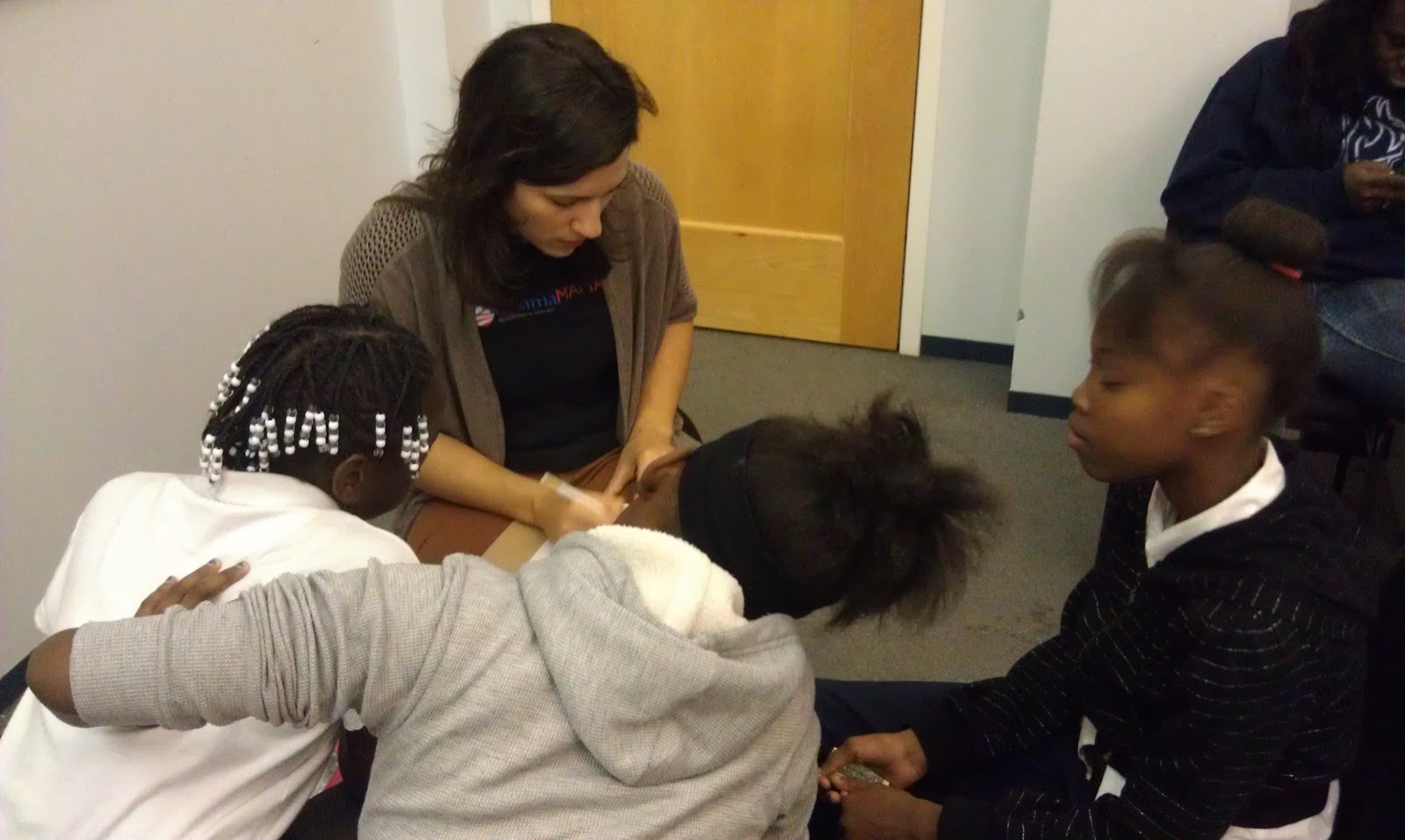
It was a pure delight to participate in Chicago Opera
Theater’s Opera for All Program for my first season as composer at two schools:
Clinton and Saint Vincent DePaul. I particularly valued the interactive aspect
of my work with COT’s elementary students. Composing is a notoriously solitary
act; in both schools, though, we enjoyed a genuine collaborative experience in
which each student had input into their songs’ rhythms, melodies, and
harmonies. My role as a composer was simply to put the students’ ideas
together.
I began
each class by asking students to read the text we would be setting. I next
facilitated discussion about the text’s emotional content and asked for another
reading emphasizing the emotions of the text. We were then able to notice when
students’ voices instinctually went up or down, when the speed increased or
decreased, and when volume changed.
Once
the broad-strokes structure of our music was on paper, I asked students at
Clinton to form small groups to collaborate on creating the rhythm of their
song. As Saint Vincent DePaul, the class size was small enough to continue our
discussion as a full group. Each group had five to ten minutes to discuss, and
then spoke the text in rhythm to the entire class. And then we voted on which
rhythm to use. We did the exact same thing when constructing a melody. This is
true composition by committee!
I offered occasional coaching: when a group
set a text to a repeated interval, I asked whether the repetition produced the
tension they had found in the text. We discussed the possibility of using
different intervals or of transposing the same interval to different scale
degrees and voted for the transposition. I also presented options for the piano
accompaniment: should it be bouncy or flowing? Should it stick to a few basic
chords or should it have more harmonic variety? But the ultimate decision was
in the hands of the students.
And so I left class each day with a
notebook full of scribbled transcriptions and jottings about decisions the
students had made. I entered the melodies directly into my notation software
and then set to work creating an accompaniment that fit the students’ intentions.
Among the highlights of my work
with Opera for All was the students’ reaction to hearing the realization of
their melodies. One young singer, who had improvised a very beautiful alien
welcome song, was particularly moved: “That’s exactly what I imagined,” she
told one of the school’s teaching artists. And she was one of many young
composers who are on the verge of bringing their imaginings to reality.
It's been so exciting to get back to our two after-school classes
at Marillac and start creating a script and dialogue for their
school-themed opera!
We had been struggling to get the kids'
creativity going: our outer space theme seemed too far removed from
their own world to resonate with their daily experiences, and they had
no interest, or ability, to create a story for characters whose
challenges were unrelated to their own. The students came in one day
after a particularly hard day at school, and we decided to ask them, as
if reporting for a TV news broadcast: Just what is bugging you all? How
was your day? Why are you all so grumpy? I thought that if we just found
the subject that the kids wanted and needed to discuss, that a creative
direction would emerge.
And of course, it did. It's amazing
how most if not all art arises from our need to process and share our
experiences, good and bad. Answers ranging from salty nachos to teachers
assigning READING (horror of horrors, 45 minutes of it!!) and asking
kids to take TicTacs came in torrents from indignant, but giggly, kids
delighting in imitating their teachers--- and quickly forgetting their
bad moods. We wrote it all down.
Going with the kids'
emotional flow, we decided to create a short opera based on the
aftermath of a bad day at school and the last day of school before
summer vacation. "After School Blues" came out of the initial discussion
with our first class, with a trio of "teachers" (reminiscent of the
Three Ladies in The Magic Flute) scolding and nagging the kids in their
imaginations prior to their entrance.
Teaching Artist, Justin, and Marillac students working through their new piece
That rhythmic number is followed
by a Marillac counselor's advice to the kids to "sing the blues" to feel
happier and the original blues song, "Not So Cool After School Blues".
Next, the kids discuss how they will spend their summer break, and
then perform "In the Summertime," a very evocative rap. The rap's first
stanza was so beautifully written by one of our older participants,
Kobe, that we followed the meter and pattern he set when creating
additional verses.
Marillac students working together to create their music.
The students have bought in 100%, with
even our most challenging and apathetic (seemingly depressed, exhausted,
or both?) kids volunteering to do verses, provide beat box beats, etc..
All but a couple of the students doing rap verses came to their second
class memorized and obviously ready to deliver their text--and the
couple who were not totally memorized quickly stepped it up and got
there. The kids were universally fascinated by the process of writing
their own dialogue and became very possessive of "their" lines. And they
have already almost learned the melody to their song. Art projects to
complete the scene are next on the docket. We've gone from struggling to
maintain order in class to rowdy but focused 99% participation. I
wouldn't be surprised if we ended up with further songs composed!
Jennifer D'Agostino - Opera for All Teaching Artist
It has been a couple weeks since I started working for
Chicago Opera Theater's "Opera for All" program and I am still amazed
at how the students react to the various aspects of putting together an opera!
Not only have they had opportunities to watch opera performances, but they also
know musical terms, sing out in class and have opinions on how the text/poetry
they have written will affect the story of their opera! I am so excited for the
plans I have made with Linden Christ for Chase Elementary and for the ideas
Mandy Compton and I have discussed for Reilly Elementary, but I'm getting ahead
of myself. Who am I and why am I so excited to work with these kids?!
My name is Jennifer D'Agostino. I grew up in Lockport, NY
and attended Baldwin-Wallace Conservatory for undergraduate college, The
University of Tennessee-Knoxville for graduate school and The University of
Wisconsin-Madison for my doctoral degree. All of my degrees are in voice
performance with specification on classical music and opera. I have performed
in many musicals and operas, have programmed about 10 different song recitals
and have even directed, assistant directed and produced shows. A lot of my time
in college was spent working in outreach, either for organized groups like the
Knoxville Opera Company, "Opera for the Young" which is based in
Madison, WI, or as part of a class. I have worked (not in music) in various
YMCA after-school programs and church school programs. I feel like my entire
life has led me to this job!
Based on what I've seen so far, I can't wait to hear the
students gain more confidence as they audition for parts in the operas they've
created. I am excited to see the different props and sets the students will
create as well as how much fun we'll all have on choreographer day! I am so
psyched to see the final performance!
At
Hampton we are off to a great start in 2013. The students at Hampton are not
singing the Blues. They are hard at work learning all there is to know about
the “Call and responses singing of spirituals”.
Hampton students are discovery and exploration singing to get ready for
their Opera. To get started in there exploration of their voices, we are studying
spirituals. At Hampton we are eagerly
learning all about the history of the folk song style of Spirituals. Originally monophonic and a cappella and
were antecedents of the blues- spirituals have a simple melodies and repeated
text, get learning tools for new singers, needing practice with their
instruments. Spirituals sometimes provided comfort and eased the boredom of
daily tasks. They were an expression of spiritual devotion and a yearning for
freedom from bondage. Sometimes they were a means of releasing pent up emotions
and expressing sorrow. But at Hampton we are studying the “Call and Response”
relationship of the singing of spirituals. My teaching partner Lisa Golda and I
began each class with a performance for three spirituals, “Wade in the Water”, “My
Lord What a Mornin”, “Sometimes I feel Like a Motherless Chil” Then we
performed each song in call and response, no matter what line I sang as the
call, Lisa sang it as a response. As always we had to have fun with, so we changed
the rhythms and pitch of ‘call and response’ to keep the class interested, and
they wanted to take part right away.
Take a
look at this Game for classroom: Tap Your Feet Students will practice
following a pattern and become familiar with the concept of beat in music. They
will be introduced to tempo. They will gain experience playing the beat on
non-pitched rhythm instruments, at various tempos. This activity will culminate
in the creation of a rhythm piece.
Objectives:
Students
will listen to, analyze, and describe music.
Students
will gain experience performing on instruments, alone and with others, a
varied repertoire of music.
Students
will gain experience composing and arranging music within specified
guidelines.
Students
will gain experience in speaking and listening as tools for learning.
Materials:
Computer(s)
with Internet access will be used for online activity
Available
non-pitched rhythm instruments
Picture
cards of non-pitched instruments with the names of the instruments written
below the picture
Big
book stand, music stand, flannel board-anything to arrange cards in
sequence from left to right
Procedure:
AccessPBS's Bandleader. Have the students work in
the first level to gain experience with following a pattern.
Have
the group find their individual heartbeats by placing their hands on their
chests. Have them tap along with their heartbeat.
Do
a few simple exercises/movements with the children to raise their
heartbeat. Immediately following this, have them find their heartbeat again.
Ask them what they notice. Is their heart beating faster or slower?
(Tempo) Explain that music can also have a fast beat or slow beat.
AccessPBS's Bandleader. As a class, create a
composition. Listen several times and help the children keep the beat with
the created composition using a different type of body percussion (pat,
tap, clap, etc.) each time. Students will attempt to follow a pattern.
Continue
to develop the concept of beat in music, creating a "beat"
composition using a variety of non pitched instruments. Have the children
select an instrument (i.e. hand drum) and play a group of four beats.
Allow children to take turns as necessary, while others practice with body
percussion.
After
the students have practiced groups of four beats on the various
instruments; ask them to suggest a sequence for the instruments to play
in. Arrange the picture cards in the sequence the students have selected
from left to right. Guide them in playing this rhythm composition.
Compose
a variety of these compositions. Play at various tempos. Try having
children play instruments in combinations (i.e. hand drum and maracas
together, triangle and claves).
Assessment:
Students
should actively participate in all activities.
Teacher
assessment of student's ability to keep a steady beat through observation.
Extensions and Adaptations
Continue
to develop the beat by using it with picture books and poems. When reading
to children, look for text that is rhythmic. Help students select
appropriate places to insert beat patterns in the story/poem.
Listen
to a variety of music with children and have them determine the beat and
play along.
Relevant National Standards:
Music
Performing on
instruments, alone and with others, a varied repertoire of music.
Composing and
arranging music within specified guidelines.
Listening to,
analyzing, and describing music.
Language Arts
Demonstrates
competence in speaking and listening as tools for learning.
Cameron
At
Cameron we are off to a fresh new start for 2013. In the afterschool program at
Cameron, we now have a new day of the week( Wednesday) and a new time, so
students can take a fresh look at Opera for all at Cameron. I don’t want to Jinks
us, but we had more than twenty students this Wednesday, at some point or
another. Already to explore opera, staging and acting and improv games for fun.
The group of five 3rd graders, ten 5th and 6th
graders, and five 7th and 8th graders, loved Zip ZapZog
and “The Impossible Dream” from Man of La Mancha. This semester students will
focus on singing in groups and their cultures, to develop a story for the
Sharing at the end of the year. So getting the students to connect with the
inner opera singer and not be shy, was the Challenge of the Year. Check out the
video below of class.
Call and Response models ways to read fluently and with
meaning and invites students to participate in an aesthetic reading of a text.
For those students who have difficulty with reading, Call and Response provides
an opportunity to practice reading a text as a community without being singled
out. The activity Call and Response comes out of traditions in the African
American church and hip-hop concerts, where vocal participation is encouraged.
Duration: 10 minutes
Preparation: Before class, select a list of key phrases or
sentences from the designated text. Virtually any lines can work, though the
best choices are lines that carry an emotional or aesthetic punch and that are
essential to an understanding of the text.
Procedure:The class
gathers in a large circle. Everyone in the room needs to be able to make eye
contact with one another. Ask the students to pull their shoulders back, take
their hands out of their pockets, and avoid crossing their arms during the
vocal warm-up. This will help them to open their voices, to speak with
conviction and clarity. Next, walk into the center of the space and call out
lines of text. The students repeat the lines back in chorus. Read with emotion,
matching the tone of the text and encouraging students to match the energy and
quality of the reading.
You might then playfully point to individual students and
challenge them to match your level of energy. The warm-up continues with many
lines, moving back and forth between you, individual students, and the entire
group.
This activity can become a daily ritual in the classroom. As
students become comfortable, they can take over the lead, calling out the lines
to the rest of the group. It’s important for student leaders to review the text
carefully beforehand, choosing, marking, and practicing the lines they will
lead the class in reading. This makes an excellent and purposeful homework
assignment.
In Daniel and Kurt’s final performance at Brown Summer High
School, the Call and Response became the opening event. An entire class stood
on the stage in a U formation. Standing in the center, three student leaders
called out lines from Whitman. The class, and eventually the entire auditorium,
repeated the lines in response. The class then added a Brazilian choral melody,
accompanied by a guitar, between the calls and responses: “I celebrate myself .
. . and sing myself.”
Reflection: Based on the lines you heard in the Call and
Response, what predictions can you make about the text?What was your favorite line of today’s Call
and Response?
What a way end the semester... with a trial! A Trial By Jury - The Gilbert & Sullivan one act operetta, that is!
On December 7 & 8 the Chicago Opera Theater for Teens group
performed at The Chicago Temple. The students did a great job and Marta
and I were very pleased. We had not attempted doing an entire opera,
and this was a perfect fit. The one act opera lasts about 35 minutes
and there is no dialogue - ALL MUSIC. We didn't have to cut a thing.
The show provided wonderful opportunities for some of the students to
really shine with individual roles. We double cast the show to give as
many solo opportunities as possible.
The cast of characters included:
The Plaintiff (Angelina), a lovely soprano role sung by Genna Simon and Morgan Holmes
The Defendant (Edwin), a scoundrel of a tenor role sung by Marcellus Burt and Torin Brown
The Judge, a comic baritone role perfect for Sakhary Prayer and Brando Crawford
The Counsel, an empathetic tenor role sung by Xxavier Jenkins and Andre Cardine
The Usher, a bass role split between Marc Morey and adapted to fit a mezzo Ruth Odukoya
Both casts did an excellent job!
This term went rather smoothly. The show being a little shorter
then we have attempted in the past seemed to let us all breath a little
and allowed everyone to really feel comfortable in their parts. We
decided to let the students have a huge part in the costuming. We all
batted around a couple of ideas on how we could dress. The
possibilities were endless, but ultimately we decided to let every
individual come up with a kind of 'iconic' societal character - i.e. we
had a cowboy, a monk, a hippie, a ballerina, a volleyball player, a
karate student, and so on and so on.... The students really took to
mostly coming up with their own ideas and I think that gave them a sense
that this whole was really about them! As we delved into the staging
we reminded the students of the character choice and guided them to
react to the situations with appropriate body language for their
particular character. If you weren't able to come to one of the
performances you missed some hilarious moments!
I think every single student grew from this experience. Marta and I
could hear the strides the students made vocally and certainly their
acting and self awareness abounded. We are proud of them all!!!
What a whirl-a-wind of a week! As the special guest lyricist, I visited
almost all our program sites, working with 14 different classes on their
songwriting skills. It was a TON of fun to see where all my fellow
teaching artists are facilitating as well as meet all their
fantastically talented students!
So, let's talk about
method. My background in lyric writing stems from creating songs that
originate from narrative writing and scriptwriting: to put in it simpler
terms, I normally write the story and/or script first, and allow that
material to inspire my songs. In the case of Opera for All, we are
primarily working with outlines and budding ideas of story lines which
poses a different challenge: write a song and form the majority of the
script around it.
My partner teaching artists
were all very helpful in getting as much material prepared for my
workshop as possible. My goal was to address each class with a
personalized songwriting workshop, generating a song that would fit in
with the main idea of their opera. Additionally, since many of the
workshops were in the beginning stages of developing story lines, I
wanted to help flush out the plot and characters. This way, the
resulting song would either introduce the main conflict, help it move
forward or resolve it. Having a structured and specific approach to
songwriting is the key to a more fun and effective workshop for the
students!
The first site I visited was the St.
Vincent de Paul Center (SVDP) with teaching artists Justin and Bryna. Their two
classes were focused on creating a song about Makin' Magic Happen. Since
their students were a variety of ages, I decided playing an active game
called Magician would help get them thinking about Magic on the same
level. After the game, we split into small groups and wrote verses
responding to questions about Magic and how the characters in their
opera might feel about Magic. The workshop at SVDP was the most
challenging in that we didn't necessarily have a story line to work
with, but through working on the song, the students started to
brainstorm ideas they wanted to have in their performance.
Next
up was Marillac, another after-school program with TA's Lisa and
Justin. Lisa and Justin face a similar situation as SVDP in that their
group had the seed of an idea for their opera; their classes were
inspired by a scene from 2001: A Space Odyssey. They invented a
situation about a girl who travels through a black hole to get away from
her parents. I decided to modify my workshop plan as I had heard
Marillac's students loved playing an improvisational song game, and were
quite good at coming up with lyrics on the spot. We used this game as a
starting point for singing about/discussing the opera's plot, as well
as having the students freestyle about traveling through a black hole
from the viewpoint of the girl.
Our
first class did a super job at this game- they were so good and so
focused that we played throughout the entire class time. The second
group was a bit more to handle, so I switched it up by breaking them up
into 3 small groups. We assigned each group a part of the song to focus
on and for which to write at least 2 verses. I had three girls who were
not only best friends, but amazing lyricists! We tackled the beginning
of the song, before the girl goes into the black hole, and the reasons
why she ran away from her parents. Then all the groups shared with each
other in the end, even adding on blocking for their song! They were
really engaged in the process.
My
final classes of the week was at Hampton with Lisa and Richard. These
classes had done a lot of brainstorming already on the plot and
characters. Beforehand, Lisa and I came up with what song we wanted
each class to write. Since these students are in-school, we were able
to do a little more in terms of teaching the actual structure of a song
and defining lyric-writing concepts such as how verses support the
chorus, what it means to scan you rhythm and how to choose a rhyme
scheme.
Following a general overview of
songwriting, we then mapped out our song from beginning to end. The
students decided on what important details to include in order to help
the audience understand the story. For example, Ms. Ochoa's class wrote a
song about the Sacred Garden on the Planet Zyrdek, sung by the
Beardnuggets, Space Doggies and the Gardeners, all governed by Princess
Roseberry. We decided what would be in the garden, how the characters
felt about their garden, why it was important to them and who they were
tending it for. Small groups each took parts of the song to write a 4
line, rhyming verse containing the information. I loved how creative
they were with the different species of plant that were in the garden-
particularly having a Golden Flower that was in the center of the
garden, and therefore the most important plant.
To
the 6th graders in Mr. McFarland's class I put the biggest challenge.
Their song introduced the characters in Hampton's opera about the Sun
going Supernova, and Earth choosing 8 specialists for a mission to the
Planet Zrydek. Instead of just 4-line verses, I tasked the students with
writing 2, 4-line rhyming verses (8 lines in all) that introduced each
specialist, included information about what they did for a living, how
they felt about the mission and what they hoped to accomplish. I have
to say, I was really impressed with the quality of their work! 8 lines
is a lot to write in 25 minutes, but the students put their heads and
talents together to write some very clever lyrics:
I
still have Clinton to visit as well as leading my own workshops at
Chase and Reilly in a songwriting adventure. I'm excited to keep
experimenting with the songwriting process to get the best results for
every site-- I know the students will continue to be a huge source of
inspiration!
Linden Christ, Manager of Education and Outreach and Founder of Chicago Opera Playhouse
Every year, all of our
schools look forward to seeing an operetta or musical at their school
performed just for the students! It is not just for the Opera for All (OFA) students, but a rare experience that the entire school gets to share. This year, Chicago Opera Playhouse performed the brand new operetta, Knightly
News by Jonathan Stinson. The OFA students worked several
weeks with their teaching artists to practice the finale chorus which
they joined in singing with the professionals at the end of the show.
School pride was bubbling over for the students when they were able to perform in front of the whole school. Their schoolmates were proud of them and equally as enamored by the opera.
Providing students with the opportunity to see an opera in their own school setting is very rewarding. The students are comfortable and enjoy the performance wholly. No one was able to keep quiet the entire time, but were chattering quietly about their favorite part, the storyline, and what they thought was funny. For many of the students, this was their first time to see an opera and will help prepare them to watch their peers in the Opera For All program at their Spring opera performance.
The partnership between Chicago Opera Theater's Opera for All program and Chicago Opera Playhouse is one I hope continues as it enriches the students' and actors' lives equally.
About the Show:
Knightly News is
an operatic news broadcast of the woes of Prince Charming and his
Tri-kingdom state of affairs, including his own search for a princess, a
missing Grandmother, and frighteningly strong winds that are blowing
down houses in the land. This fun-filled show had the entire student
body talking about fairy-tales and humming melodies for weeks to come!
The
students favorite parts included the Wolf playing maracas and
interrupting Prince Charming's solo. Everyone was laughing when the
character broke the 4th wall during the chase scene when the students
had to protect Little Red Riding Hood & Pyg from that Big Bad Wolf.
They survived with a quick swipe of the slipper thanks to the Wolf
that knocked the Prince straight to the floor!
To learn more about Knightly News and to schedule a performance for the children in your life visit: www.chicagooperaplayhouse.com